
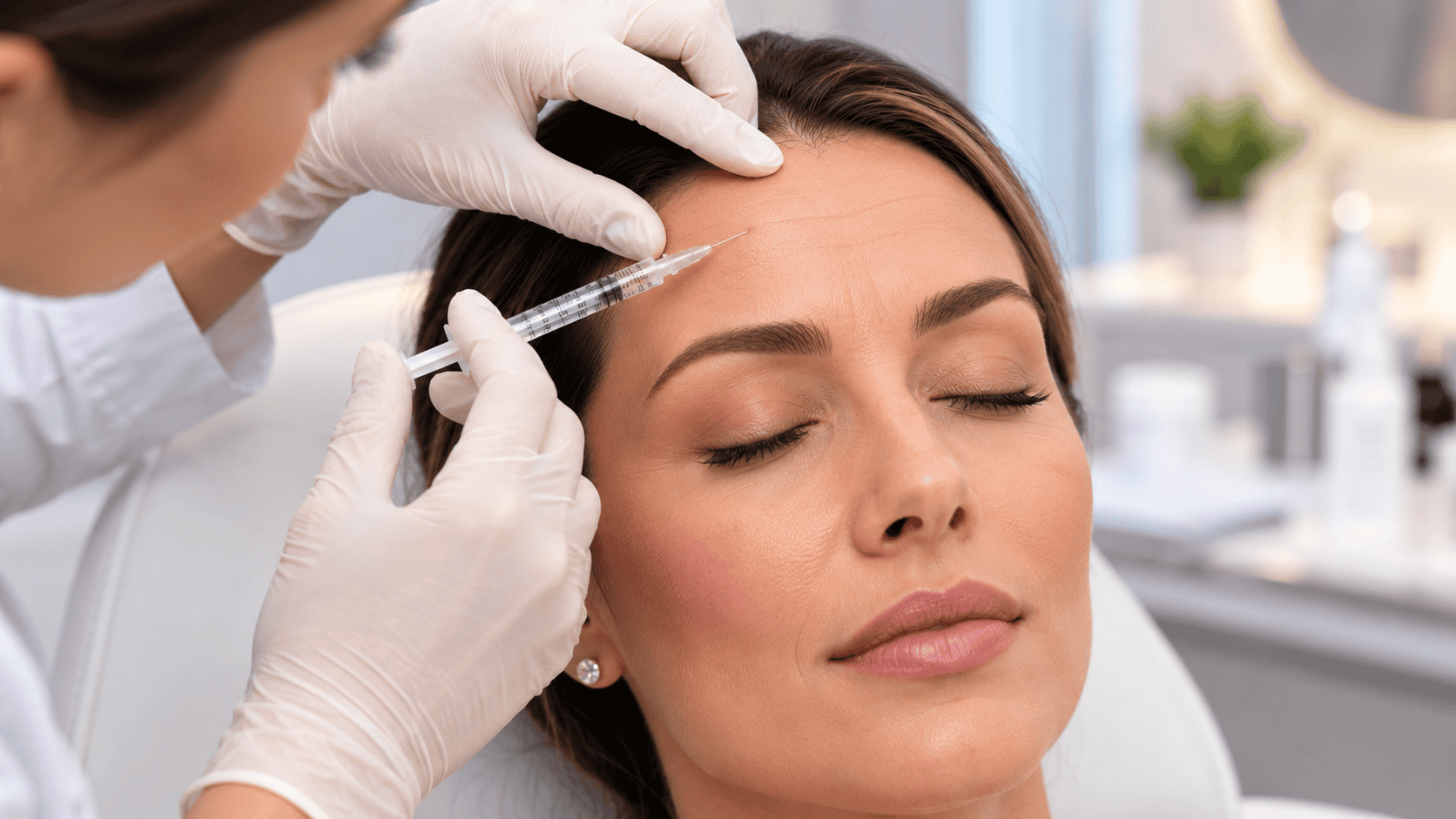
Determining how many units of BOTOX® you need for your forehead is not a one-size-fits-all calculation. A truly refreshed look requires a customized, patient-tailored approach rather than a single rigid number pulled from a chart. While many individuals begin their aesthetic journey with a conservative starting range, the exact dosage depends entirely on your unique facial anatomy, muscle strength, and aesthetic goals. At Goldfingers Aesthetics, our Allergan-trained providers, ranked in the Top 1% nationally, focus on subtle, natural-looking enhancements that soften lines while preserving your natural facial expressions.
Understanding the Modern Approach to Forehead BOTOX® Units
Aesthetic treatment philosophy has shifted. The change is significant. Where older protocols often aimed for complete muscle freezing, producing the stiff, expressionless look that still makes people nervous, the current global clinical consensus has moved decisively toward neuromodulation, a technique that uses targeted, lower doses to quiet muscle activity rather than eliminate it entirely (per the Global Aesthetics Consensus on neuromodulators and dosing paradigms). The practical result is that patients keep their natural facial animation while horizontal forehead lines soften meaningfully.
This shift matters because it reframes what "enough units" actually means. The goal is calibrated relaxation, not paralysis, which is why experienced injectors spend time evaluating how your specific muscles contract before deciding on a dose. Botulinum toxin type A injection has become the leading nonsurgical aesthetic treatment globally, with the American Society for Aesthetic Plastic Surgery reporting more than 3.5 million procedures in 2014 alone (per the Global Aesthetics Consensus study, linked above). The demand has only grown since. That volume of clinical experience has generated a sophisticated body of evidence supporting lower, more precise dosing strategies over the blunt high-dose approaches of earlier years.
Because evolving patient demographics across different ages, genders, and ethnicities require highly individualized treatment plans, providers must perform a detailed diagnostic evaluation before administering any product (per the Global Aesthetics Consensus study, linked above). By prioritizing that personalized assessment, injectors ensure the safe number of BOTOX® units for forehead treatments is calibrated precisely to your muscle mass and contraction patterns, preventing overcorrection and maintaining facial harmony rather than trading one problem for another.
The Anatomy of the Forehead: Why the Frontalis Muscle Dictates Your Dosage
Understanding how your dosage is calculated starts with the underlying anatomy of the upper face. Every face is different. The frontalis muscle is the expansive sheet of muscle covering your forehead, and it carries a singular responsibility: lifting your eyebrows and generating horizontal forehead wrinkles when it contracts (per the Global Aesthetics Consensus study, linked above). What makes this muscle particularly sensitive to dosing decisions is that it works in direct opposition to the depressor muscles that pull your brows downward. Injecting too many units, or placing them incorrectly, can tip that balance, causing the brow to drop and creating a heavy, fatigued appearance that patients often describe as looking worse than before treatment.
Several anatomical factors determine where your dosage lands on the spectrum:
- Muscular Strength: Individuals with stronger, more active frontalis muscles naturally require a higher number of units to achieve optimal relaxation. A provider who skips a thorough muscle assessment risks under- or over-treating from the start.
- Gender Differences: Male patients typically have greater muscle mass in the upper face, often requiring a proportionally higher dose than female patients to achieve comparable softening of lines.
- Forehead Height and Surface Area: A broader forehead with more expansive horizontal lines requires strategic, widespread placement of units to ensure an even, smooth result rather than patchy relaxation.
- Deeper, static lines that remain visible even at rest may call for a multi-modality approach, combining neuromodulators with volume restoration, while dynamic lines that only appear during expression generally respond well to toxin alone.
Ready to discover the perfect, customized dosage for your unique features? Schedule a personalized consultation with our Top 1% Allergan-trained injectors at Goldfingers Aesthetics by calling (407) 333-4300.
Typical BOTOX® Dosage for Forehead Lines and Adjacent Areas
[Inline Image]PLACEHOLDER A warm, professional clinical consultation setting at Goldfingers Aesthetics. A provider in a white coat leans forward attentively across a clean desk, reviewing a facial anatomy diagram with a patient. Soft natural light filters through large windows. The mood is calm, personalized, and reassuring. Style: clean, modern medical-aesthetic photography with warm neutral tones.[/Inline Image]
Allergan's manufacturer guidelines do not specify a single rigid unit range for the frontalis muscle alone, given how greatly anatomy varies across patients. In clinical practice, injectors typically begin with a conservative starting dose and evaluate the response at a two-week follow-up appointment. This "start low and go slow" philosophy exists for a simple reason: adding units at a follow-up is always possible, but removing them once injected is not. Safety is our priority. That difference makes conservatism the rational default, especially for first-time patients whose muscle behavior under treatment is still unknown.
Modern aesthetic medicine also strongly recommends treating the forehead as part of a panfacial approach rather than in isolation (per the Global Aesthetics Consensus study, linked above). The muscles of the upper face operate as an integrated system, meaning when one area is treated without accounting for adjacent zones, compensatory muscle recruitment can shift the problem rather than solve it. Forehead treatments are therefore frequently paired with treatments in the glabellar complex, the area between the eyebrows responsible for the vertical "11" lines. A meta-analysis of four trials involving 621 patients confirmed that a 20-unit treatment of the glabellar complex produced sustained clinical benefits for four months in more than half of responders (per the NIH clinical study on glabellar complex dosing). Treating both zones together produces a more balanced, harmonious result than addressing either one alone.
- Horizontal Forehead Lines: Treated with a highly customized number of units tailored to your frontalis muscle strength, forehead dimensions, and treatment history. No universal figure applies here; your provider's assessment determines the starting dose.
- Glabellar Complex (Frown Lines): The standard clinical dose of 20 units (per the NIH clinical study on glabellar complex dosing, linked above) addresses the "11" lines between the brows and is among the most well-supported dosing recommendations in the literature.
- Lateral Canthal Lines (Crow's Feet): A trial of 917 subjects demonstrated that treating crow's feet with 12 units per side alongside the glabellar complex delivered greater aesthetic benefits and patient satisfaction than treating either area in isolation (per the Global Aesthetics Consensus study, linked above), making combined upper-face treatment a well-evidenced strategy.
What Happens If You Get Too Much BOTOX® in the Forehead?
[Inline Image]PLACEHOLDER A clean, high-quality anatomical illustration of the upper face showing the frontalis muscle spanning the forehead and its relationship to the brow-depressing muscles below. The illustration uses a warm, clinical-educational style with labeled muscle groups. Soft gradient background in neutral cream and light blue tones. The style is precise and professional, suitable for a medical aesthetics blog.[/Inline Image]
Receiving an excessive number of units, or undergoing treatment from an injector who hasn't mapped your anatomy carefully, can produce complications that are frustrating precisely because they're temporary but not immediately reversible. The most common result of over-treating the frontalis is brow ptosis: a heavy, flat, or drooping eyebrow appearance that results from removing the muscle's lifting capacity without accounting for the balance of forces acting on the brow. Because the frontalis is the sole elevator of the brows, over-relaxing it leaves the depressor muscles working unopposed, pulling the brow downward and making the eyelids feel weighted and difficult to open fully.
Beyond brow ptosis, patients who receive too many units in the forehead sometimes describe a sensation of pressure across the upper face, a loss of the subtle expressiveness that makes their face feel like their own, and, in cases of very high doses, a visible flattening of the forehead that reads as unnatural even to untrained observers. None of these outcomes are permanent, since the product metabolizes over time and muscle function returns. This brings peace of mind. However, they underscore why provider selection and a thorough pre-treatment assessment matter far more than finding the lowest price per unit. The complication rate for cosmetic neuromodulator procedures is low across age groups, as a historical review found a rate of just 1.94% in patients over 65 compared to 1.84% in younger patients (per the Global Aesthetics Consensus study, linked above). Those numbers reflect procedures performed by experienced clinicians following evidence-based protocols, not rushed or under-assessed treatments.
Don't risk the heavy, "frozen" look of over-treatment. Trust your face to the Top 1% Allergan-trained experts at Goldfingers Aesthetics. Book your customized consultation today.
Maintaining Your Glow: Forehead BOTOX® Results and Maintenance
Understanding what to expect after treatment and how to protect your results is just as important as the dosing conversation itself. Consistency is key. Forehead BOTOX® is not a one-and-done procedure; it's a maintenance relationship between your muscle activity, your skin quality, and your provider's ongoing assessment of how your face responds over time.
- Initial Onset: Results become visible gradually as the product takes effect. The exact timeline varies by individual, and your provider will schedule a follow-up appointment to assess your response and make any necessary adjustments.
- Average Duration: Muscle movement returns gradually as the product metabolizes. The duration varies from patient to patient, which is why your provider's observation of your specific response over multiple sessions informs the optimal maintenance schedule for you.
- Treatment Frequency: Most patients schedule maintenance appointments three to four times a year, a cadence that aligns with the natural lifespan of the product and prevents lines from fully re-establishing between sessions.
- The Role of Sun Protection: For patients in Florida, where UV exposure is a year-round reality, combining BOTOX® treatments with medical-grade sun protection is essential. Sun damage accelerates the formation of static lines, the kind that persist even at rest, and can alter how the skin responds to treatment over time. Protecting your investment means protecting your skin daily, not just on treatment days.
Different commercial formulations of neuromodulators are also worth understanding, particularly if you're comparing providers or considering switching products. Each formulation, including onabotulinumtoxinA, abobotulinumtoxinA, and incobotulinumtoxinA, is chemically and pharmacologically distinct. Their doses are not interchangeable, and their dose-response curves do not run parallel to one another (per the Global Aesthetics Consensus study, linked above). As a concrete example, 1 unit of BOTOX® is equivalent to approximately 2 to 4 units of Dysport (per the clinical study on neuromodulator unit conversion ratios). An injector who doesn't understand these conversion ratios precisely, or who applies one product's dosing logic to another, introduces meaningful uncertainty into your outcome. This is one of the clearest arguments for choosing a provider with deep, product-specific training rather than a generalist who treats all formulations as equivalent.
Frequently Asked Questions About Forehead BOTOX®
Is 20 units of BOTOX® enough for forehead lines?
Twenty units is a very common starting point for treating the upper face, but whether it's enough depends on your specific muscle strength, forehead dimensions, and whether adjacent areas like the glabellar complex are being treated in the same session. For some patients, 20 units distributed strategically across both the forehead and the frown lines produces a beautifully balanced result. Others, particularly those with stronger or larger frontalis muscles, may need additional units to achieve their desired level of relaxation. Your provider's assessment at the two-week follow-up is the most reliable indicator of whether your starting dose was right or whether a small adjustment would serve you better.
Is $10 a unit good for BOTOX®?
A price of $10 per unit is generally considered highly competitive, and in some markets it falls below the going rate. That said, unit price is only one variable in the total value equation. The more important factors are your injector's training credentials, their familiarity with facial anatomy, the sterility of their handling protocols, and whether they perform a genuine pre-treatment assessment or simply inject a standard dose regardless of your anatomy. A lower price from an under-qualified provider can cost far more in corrective treatments, or in waiting out an unwanted result, than a higher price from a skilled clinician would have.
How far do 20 units of BOTOX® go?
In clinical practice, 20 units is typically sufficient to treat one moderate-sized area of the upper face. The most well-supported application is the glabellar complex, the frown lines between the brows, where a 20-unit dose has demonstrated sustained benefits for four months in more than half of patients across multiple clinical trials (per the NIH clinical study on glabellar complex dosing, linked above). When applied to the forehead, 20 units can soften moderate horizontal lines in patients with average muscle mass, though the distribution of those units across injection points matters as much as the total number.
What will 40 units of BOTOX® cover?
A total of 40 units generally provides enough coverage to address multiple zones of the upper face in a single session. Depending on your individual anatomy, this dosage can comfortably span the horizontal forehead lines, the glabellar complex, and the lateral canthal lines around the eyes. The allocation across those areas is not fixed, meaning a provider who finds your crow's feet are minimal might direct more units toward the forehead, while someone with pronounced frown lines might need the balance shifted toward the glabellar complex. The 40-unit figure is a useful planning benchmark, but the distribution is always anatomy-driven.
Is BOTOX® four times a year too much?
Receiving BOTOX® four times a year, roughly every three months, is a standard and well-established maintenance schedule, not an aggressive one. This frequency aligns with the natural timeline of the product's effects, allowing you to maintain a consistently smooth appearance without allowing lines to fully re-establish between sessions. Some patients find that with consistent treatment over time, their muscles gradually respond to lower doses, which can make maintenance both more efficient and more cost-effective. Your provider will track your response across sessions and adjust the schedule if your anatomy calls for it.
Book Your Consultation Today
Beginning your self-care journey with the right provider makes every subsequent decision easier. We are here to help. At Goldfingers Aesthetics, the consultation is where the real work starts: mapping your facial anatomy, understanding your goals, and designing a treatment plan that enhances what's already there rather than replacing it with something generic.
Take the next step toward a refreshed, confident you. Contact Goldfingers Aesthetics today at (407) 333-4300 to book your personalized consultation, or visit one of our convenient Florida locations.