
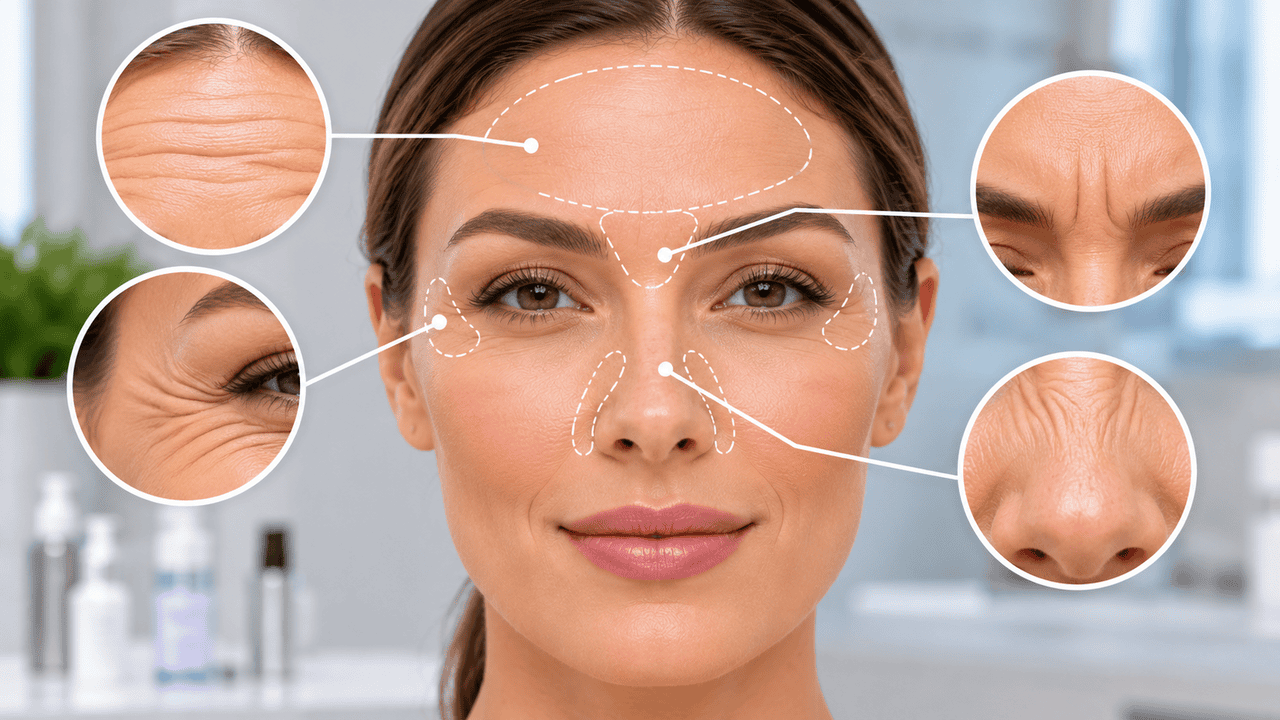
If you are researching wrinkle-relaxers but worry about looking frozen or unnatural, the answer lies in precise, personalized dosing. How many units of a wrinkle-relaxer you need depends on four intersecting variables: the specific facial area being treated, the mass and contraction strength of the underlying muscle, the depth of your existing dynamic lines, and your personal aesthetic goals. There is no universal formula. Every face requires unique consideration. Upper facial zones, including the forehead, glabella, and crow's feet, are the most commonly treated areas. Even within those zones, dosing varies considerably from one person to the next. A full-face treatment plan looks different for a 28-year-old seeking preventative care than it does for a 50-year-old addressing established creases. Both plans differ again based on anatomy, gender, and how expressively your muscles move.
When wrinkle-relaxers are administered by Allergan-trained, Top 1% national providers led by Dr. James Young, DO, the outcome is never the stiff, expressionless look that concerns most first-time patients. Precision dosing means you still look entirely like yourself: rested, refreshed, and at ease.
Understanding BOTOX® Units and How They Work Across Facial Areas
A unit of wrinkle-relaxer measures a precise quantity of biological activity: it reflects the potency of the purified protein, not a volume of liquid. Two syringes can contain identical volumes of fluid yet deliver entirely different biological effects depending on concentration. This distinction matters because it explains why dosing conversations should always center on units rather than on how much product was drawn into a syringe.
Wrinkle-relaxers work by softening the muscle contractions that cause lines. Think of it as giving your expressions permission to rest. Results remain subtle and soft. The purified protein temporarily interrupts the nerve signal that tells a specific muscle to contract. With that signal quieted, the overlying skin stops being repeatedly folded and creased during expression, allowing existing lines to soften and new ones to form more slowly. Critically, dosing is calibrated to the depth and movement strength of each individual muscle. A well-placed, correctly dosed treatment preserves the warmth of a genuine smile and the openness of a natural brow: it simply removes the tension that was aging your skin faster than necessary.
Primary Upper Facial Treatment Zones and Dosing Variations
The upper face accounts for the majority of wrinkle-relaxer treatments, and for good reason: the frontalis, corrugator, procerus, and orbicularis oculi muscles are among the most active on the face. They fire hundreds of times a day during conversation, concentration, and emotional expression. Movement is continuous. Over years, that repetitive movement etches lines into skin that was once elastic enough to spring back completely. Treating these muscles requires a coordinated approach, because they function as a system: adjusting one without considering the others can shift the balance of brow position and facial movement in ways that look unnatural.
- Glabellar Lines (Frown Lines / "11s"): The vertical creases between the eyebrows form when the corrugator supercilii and procerus muscles draw the brows inward and downward. These muscles tend to be among the strongest in the upper face, particularly in men and in individuals who concentrate or squint frequently. Treating this zone requires precise placement across multiple injection points to achieve balanced relaxation without affecting adjacent muscles that govern brow movement.
- Forehead Lines (Frontalis Muscle): Horizontal creases across the forehead develop as the frontalis muscle repeatedly lifts the brows. Because the frontalis is the primary brow elevator, dosing here demands careful calibration: too aggressive an approach can cause brow heaviness or a flat, expressionless appearance. We always assess forehead dosing in direct relationship to the glabella, because treating one without the other frequently produces asymmetrical results.
- Crow's Feet (Orbicularis Oculi): The fine lines that radiate from the outer corners of the eyes during smiling and squinting are caused by the circular orbicularis oculi muscle. Softening these lines keeps the eyes looking open and warm without eliminating the natural animation that makes a smile genuine. Dosing here is typically lighter than the glabella, reflecting the relative delicacy of the muscle and the importance of preserving natural expression around the eyes.
"Went to the Dr Phillips location for Botox; excellent MD did my Botox, his assistant was wonderful, have had Botox at 2 other places and this place by far is the best. This place is the best." - Britney M.
Experience Precision Aesthetic Care
Goldfingers Aesthetics offers personalized consultations led by Dr. James Young, DO, and Allergan-trained specialists across Florida to determine your exact unit needs for a natural, rested look. Call us at (407) 333-4300 to schedule your customized assessment.
Lower Face and Specialized Aesthetic Treatment Areas
Lower facial treatments shift the clinical focus from smoothing dynamic expression lines to reshaping muscle function, correcting asymmetry, and refining facial contour. These muscles govern chewing, speaking, and smiling, which means the margin for error is narrower, and the injector's anatomical knowledge becomes the most important variable in the room. Precision is essential. Patients who are new to lower face treatments are sometimes surprised by how much a targeted, conservative dose can alter the overall balance of their profile without changing the way they look in any dramatic or obvious way.
The masseter muscle, which anchors along the jawline and powers the chewing motion, is a frequent target for patients seeking both aesthetic contouring and relief from bruxism-related jaw tension. When the masseter is hypertrophied, often enlarged from chronic clenching or grinding, it can create a wide, squared jawline that many patients find incongruent with their desired facial shape. Relaxing this muscle over a series of treatments gradually reduces its bulk, softening the jaw's silhouette while simultaneously alleviating the chronic tension headaches and tooth wear that often accompany bruxism. Because the masseter is one of the body's most powerful muscles, it requires meaningfully higher unit doses than the delicate muscles of the upper face.
- Lip Flip (Orbicularis Oris): A micro-dose of wrinkle-relaxer placed along the upper border of the orbicularis oris softly rolls the upper lip outward, creating the appearance of subtle, natural fullness without dermal filler. The effect is understated by design: this is one of the most dose-sensitive treatments on the face, where a few extra units can impair speech or the ability to use a straw.
- Bunny Lines (Nasalis Muscle): The diagonal creases that appear along the sides of the nasal bridge during laughter or exaggerated expression are caused by the nasalis muscle. These lines often become more visible after glabellar treatment, as the compensatory muscle activity shifts. Addressing them requires only a small dose placed with precision to avoid affecting nearby muscles involved in lip movement.
- Dimpled Chin (Mentalis Muscle): An overactive mentalis creates the cobblestone or "orange peel" texture on the chin that many patients find aging and difficult to address with skincare alone. Relaxing this muscle produces a noticeably smoother lower profile and can subtly elongate the appearance of the chin.
- Platysmal Bands (Neck Lines): The vertical cords that become visible along the neck, particularly during tension or expression, are caused by the platysma muscle. Targeted injections along these bands relax the downward pull on the lower face, contributing to a lifted jawline appearance and a smoother neck profile overall.
"I love going to the Lake Mary location. The staff is super friendly and yet very professional. I go to see Dr. Nguyen; he is the best at injections. I never have any bruising." - Marti R.
Key Physiological Factors That Impact How Many Units You Need
Published unit ranges for each facial area are useful starting points, but they are reference frames, not prescriptions. The actual dose that produces your optimal result depends on anatomy that no chart can capture in advance. Muscle fiber density is one of the most significant variables: thick, well-developed muscles require more units to achieve the same degree of relaxation as a thinner muscle in the same anatomical location. This is why men consistently require higher doses than women for equivalent areas, and why two women of the same age and facial structure may still need different unit counts based on how expressively and forcefully their muscles move.
Skin quality adds another layer of complexity. Texture matters. Patients with thinner, more sun-damaged skin may see faster surface results from a given dose, while those with thicker dermis may require slightly more to achieve visible softening of established creases. Prior treatment history also matters; muscles that have been consistently relaxed over several years often require maintenance doses that differ from what was needed at the outset, as the muscle's habitual contraction patterns shift over time. There is also the question of symmetry: most faces carry subtle asymmetries in muscle strength and movement, and a skilled injector accounts for those differences rather than applying identical doses to both sides.
"My experience at Goldfinger's has always been very positive. The office is clean, professional, and efficient. Dr. Young and his assistant work as a team to make sure that placement is appropriate with the fillers and, as a double-check on everything, which I like. I have always been satisfied with the results and have never had to take them up on the offer to come back. I have been getting Botox for years in many different settings, but since coming here a couple of years ago, I have stayed. I am very happy with this office, the staff, and the products." - Mary H.
Ready for Your Personal Treatment Plan?
Unit requirements are entirely individual. Schedule a private assessment with Goldfingers Aesthetics' top-ranked team to receive a tailored unit estimate designed around your natural beauty. Call (407) 333-4300 or visit one of our Florida locations to get started.
Evolutionary Dosing: How Treatment Needs Change Over Time
Your relationship with wrinkle-relaxers is not static. Dosing needs evolve. The dose that makes sense at your first appointment reflects your muscle patterns at that moment, and those patterns shift meaningfully over months and years of consistent treatment.
- Initial Correction Phase: First-time patients typically begin with an optimal baseline dose calibrated to relax active, established muscle patterns and soften the dynamic creases that have developed over years of expression. This starting point is determined through a thorough in-person assessment, not through a standard formula.
- Maintenance and Prevention Cycles: With consistent treatments spaced every few months, muscles gradually adapt to a lower baseline of contraction. Many patients find that over time, their refreshed appearance is maintained with consistent or modestly reduced unit counts as the muscle's habitual tension patterns soften.
- Long-Term Aesthetic Planning: Aging naturally alters skin elasticity, facial volume, and the relative contribution of different muscles to surface texture. A well-managed long-term plan accounts for these shifts, periodically recalibrating the balance between wrinkle-relaxers and other restorative care to ensure results remain cohesive and natural-looking as your face evolves.
Initial results typically begin to appear within 3 to 4 days following treatment, with full muscle relaxation and optimal aesthetic settling occurring between 10 and 14 days. Patients sometimes notice subtle residual movement during this window and interpret it as incomplete treatment: in most cases, that movement is intentional. Preserving a degree of natural animation around the eyes and brows is a deliberate clinical choice, one that keeps results looking warm and human rather than static. A follow-up assessment at the two-week mark allows your provider to evaluate the outcome and make any minor refinements before your next cycle.
Frequently Asked Questions About Facial BOTOX® Units
How much area do 20 units of BOTOX® cover?
Twenty units of BOTOX® typically cover one primary treatment zone, such as the lines between the eyebrows or horizontal forehead lines, depending on muscle strength and individual facial movement. Some patients with lighter muscle activity may find that 20 units addresses a single area comfortably, while others with stronger musculature may require more to achieve the same degree of relaxation in that same zone.
How soon will I see results after my treatment?
Initial softening of dynamic lines typically begins within 3 to 4 days following injection, with full aesthetic results and optimal muscle relaxation developing between 10 to 14 days. The two-week mark is the standard window for evaluating your outcome and determining whether any refinements are warranted before your next scheduled treatment cycle.
Do dynamic wrinkles age faster or worsen if you stop getting treatments?
No. Discontinuing treatment does not accelerate aging. Your targeted facial muscles simply regain full contraction capability over time, and your skin gradually resumes its natural, baseline aging process. The lines that were softened by treatment will return as the muscle activity resumes; they will not be deeper or more pronounced than they would have been had you never treated them.
At what age is starting preventative treatments most effective?
Preventative treatments are often most effective in the late 20s to early 30s, when dynamic lines begin to form during facial expressions but have not yet etched permanently into static creases when the face is at rest. Addressing muscle activity at this stage can meaningfully slow the progression from dynamic lines, those that appear only during expression, to fixed creases that remain visible even when the face is completely relaxed.
What is the difference between unit dosing for men versus women?
Men generally require higher unit doses for the same facial areas because male facial muscles, particularly the glabella and masseters, typically carry greater mass, thickness, and contraction strength than female muscle tissue. This is not a minor variation; in some areas, the difference in required units between a male and female patient of similar age and expression habits can be substantial. Providers who do not account for this distinction risk under-treating male patients and producing results that fade faster than expected.
Determining how many units of wrinkle-relaxer you need is ultimately a conversation between your anatomy and a provider who knows how to read it. The ranges discussed here offer a useful orientation, but the number that matters is the one determined during your in-person assessment, calibrated to your muscle strength, your skin, your expression patterns, and the specific outcome you are working toward. Wrinkle-relaxers, when administered with genuine clinical precision, become less of a cosmetic intervention and more of an indulgent self-care ritual that helps you look exactly like yourself, only completely rested. That distinction, between chasing a look and refining your own, is what separates a tailored aesthetic plan from a generic one.
Schedule Your Customized Facial Assessment
Take the next step toward your most refreshed self. Contact Goldfingers Aesthetics at (407) 333-4300 or visit our locations across Florida, including Winter Park, Lake Mary, Downtown Tampa, and Orlando, to schedule your personalized aesthetic consultation with our Top 1% national provider team.